Scientific notation is a shorthand way of writing very large or very small numbers using a combination of a number between 1 and 10 and a power of 10. This notation is essential in various fields, including physics, chemistry, and engineering, where calculations involve extremely large or small quantities. Performing operations with scientific notation requires a solid understanding of the concept and practice with worksheets and exercises.
The use of scientific notation simplifies complex calculations and makes it easier to compare and manipulate large or small numbers. However, it can be challenging for students to grasp the concept and apply it to various mathematical operations. A well-structured worksheet on performing operations with scientific notation can help learners develop their skills and build confidence in handling scientific notation.
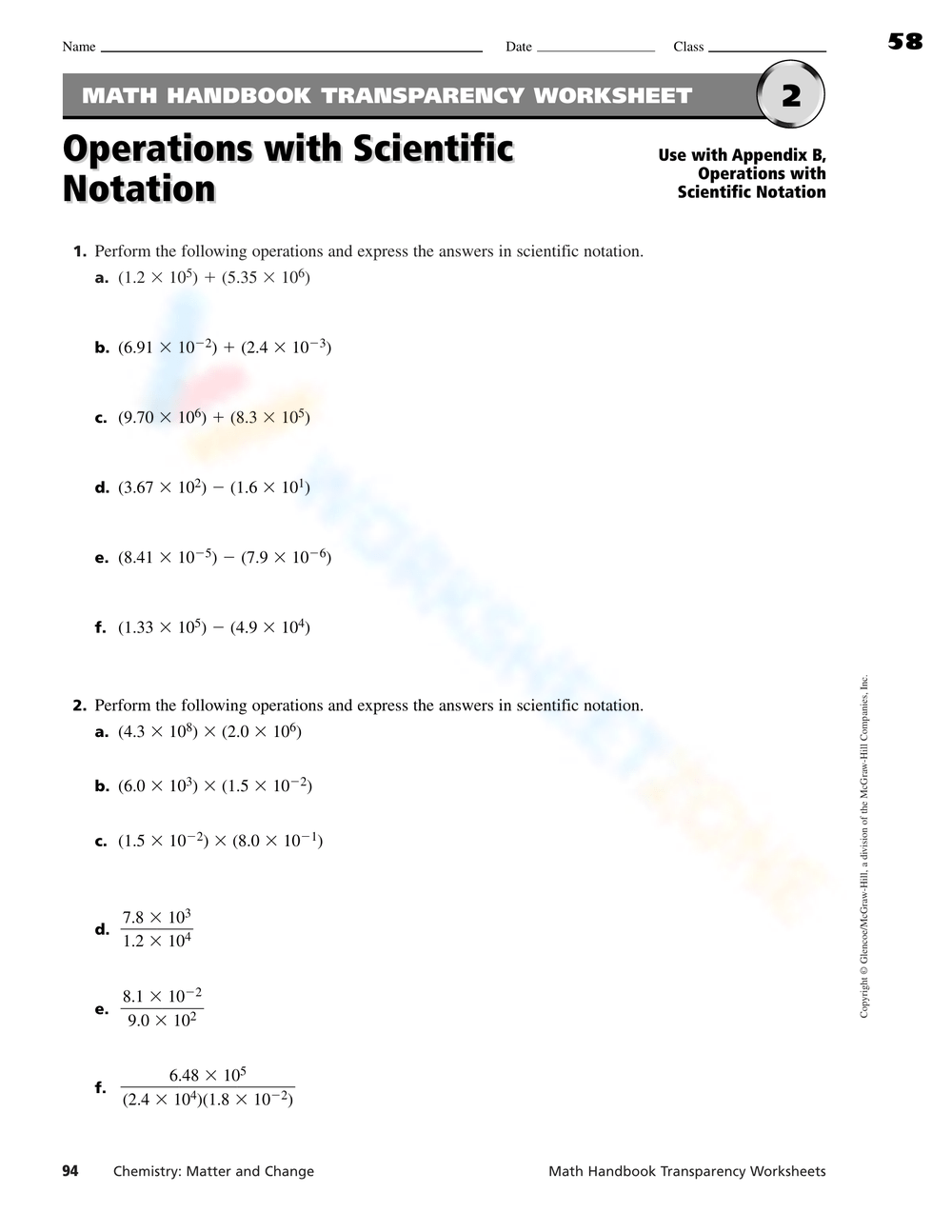
Scientific Notation Operations Practice Worksheet
Understanding the Basics of Scientific Notation
To understand the basics of scientific notation, it’s crucial to know how to convert numbers to and from scientific notation. This involves expressing a number as a product of a number between 1 and 10 and a power of 10. For example, the number 456 can be written in scientific notation as 4.56 x 10^2. Understanding the rules of exponents and how to apply them when converting numbers is vital for performing operations with scientific notation.
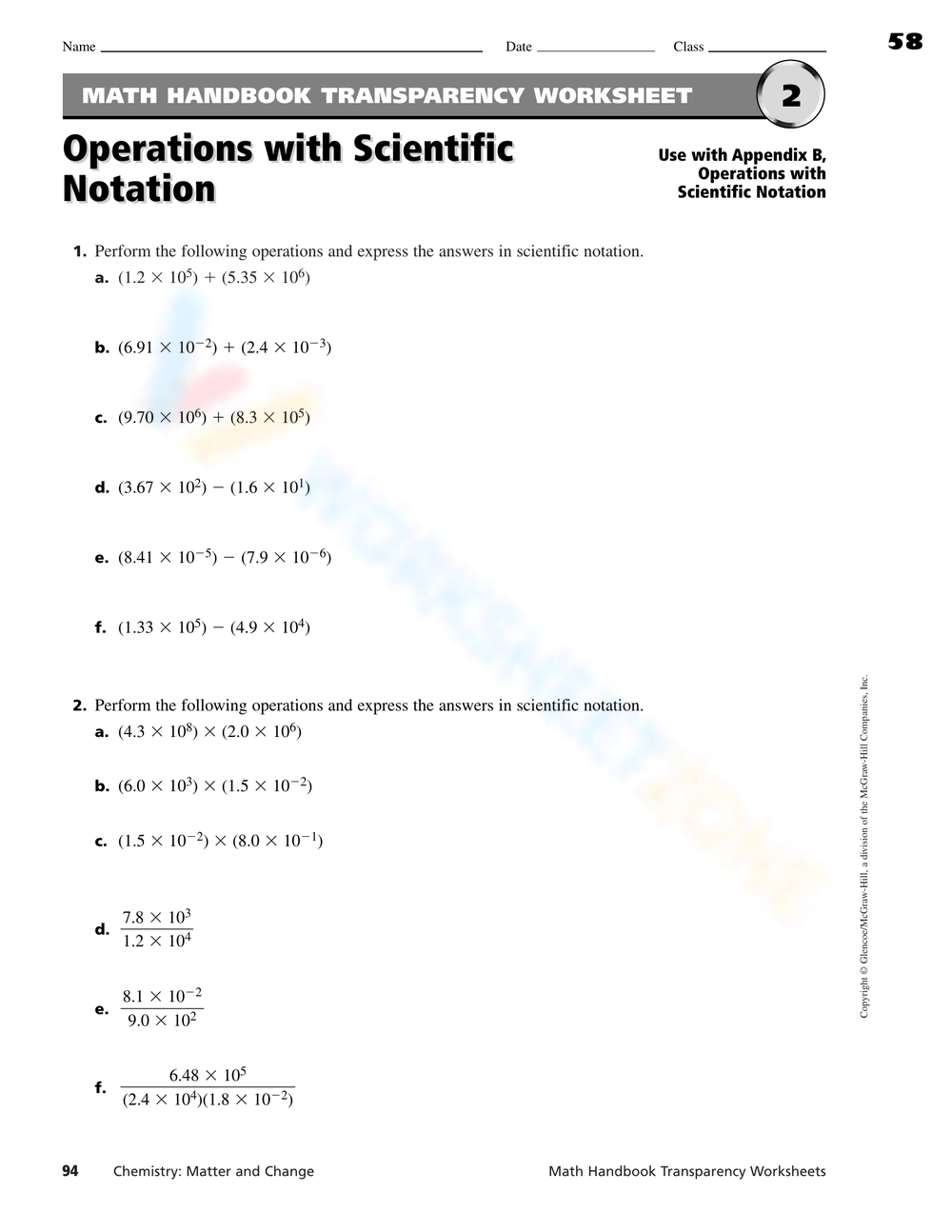
Scientific Notation Operations Practice Worksheet
Adding and Subtracting with Scientific Notation
When adding and subtracting numbers in scientific notation, it’s essential to ensure that the exponents are the same. If the exponents are different, the numbers must be converted to have the same exponent before performing the operation. For instance, to add 2.5 x 10^3 and 3.7 x 10^2, the numbers must be converted to have the same exponent, resulting in 2.5 x 10^3 + 0.37 x 10^3. Then, the numbers can be added, resulting in 2.87 x 10^3.
Multiplying and Dividing with Scientific Notation
Multiplying and dividing numbers in scientific notation involves applying the rules of exponents. When multiplying, the exponents are added, and when dividing, the exponents are subtracted. For example, to multiply 4.2 x 10^2 and 3.1 x 10^3, the exponents are added, resulting in 4.2 x 3.1 x 10^(2+3) = 13.02 x 10^5. Similarly, when dividing 6.3 x 10^4 by 2.1 x 10^2, the exponents are subtracted, resulting in 6.3 / 2.1 x 10^(4-2) = 3 x 10^2.
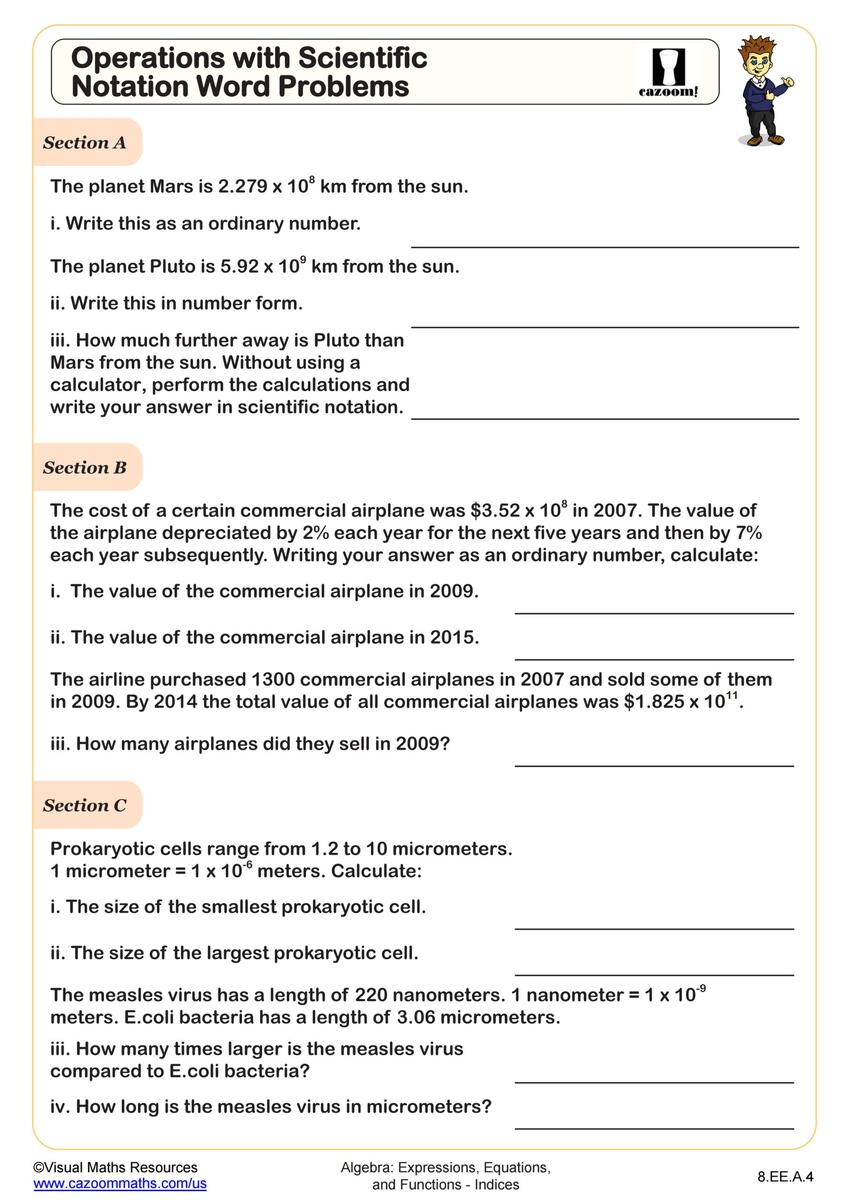
Operations With Scientific Notation Word Problems Worksheet 8th Grade PDF Worksheets Cazoom Math
By practicing with a performing operations with scientific notation worksheet, students can develop their skills and become proficient in handling scientific notation. The worksheet should include a variety of exercises that cover addition, subtraction, multiplication, and division, as well as converting numbers to and from scientific notation. With consistent practice and review, learners can master the concept of scientific notation and apply it to real-world problems with confidence.
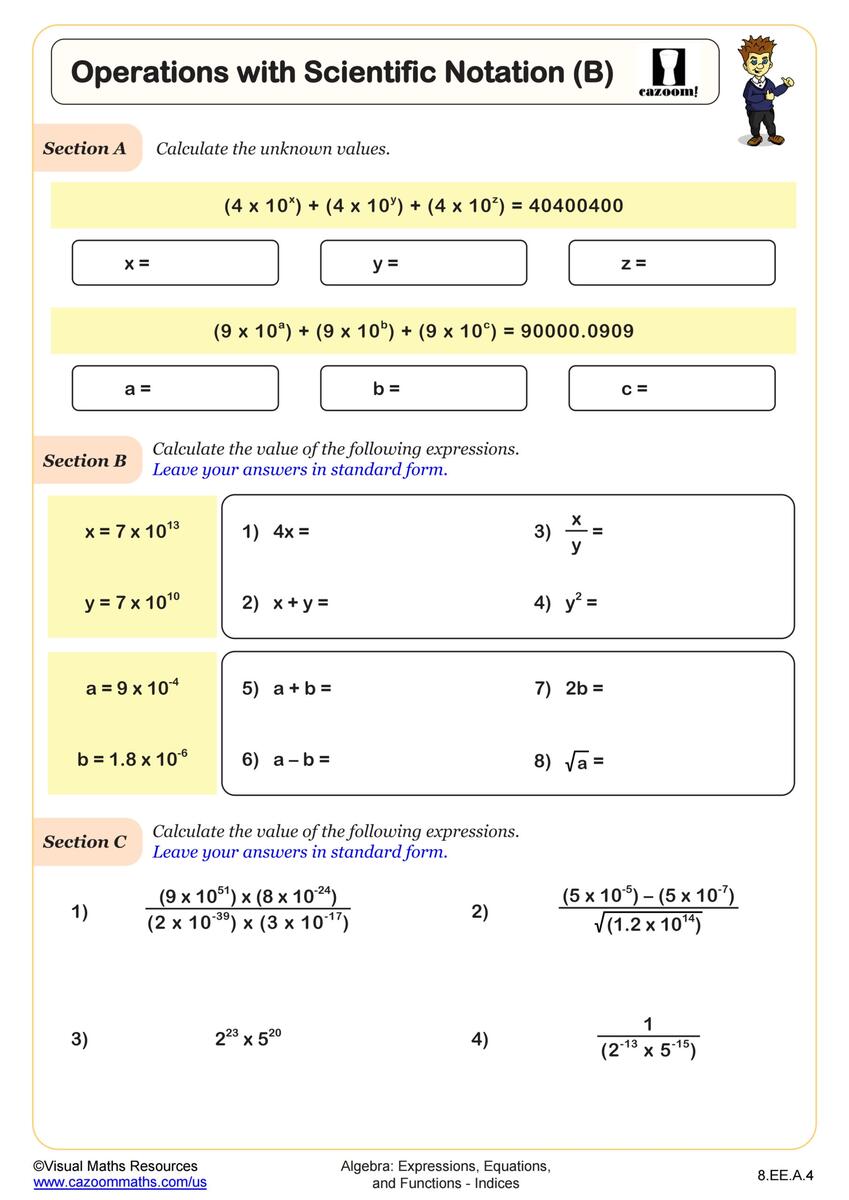
Operations With Scientific Notation B Worksheet PDF Printable Algebra Worksheet Cazoom Math
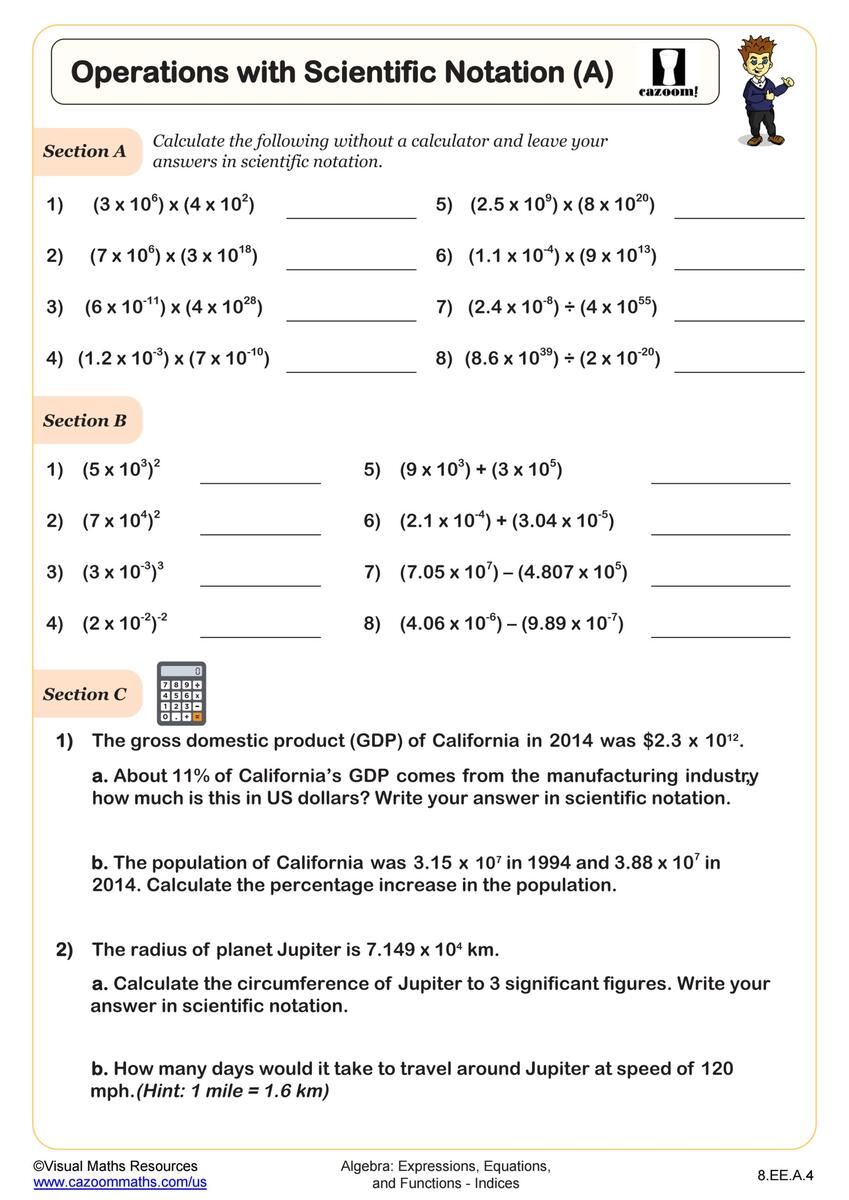
Operations With Scientific Notation A Worksheet Fun And Engaging 8th Grade PDF Worksheets Cazoom Math